Translating Enterprise Strategy, Product Releases, and AI Workflows into High-Adoption Learning Portals
Outcome First
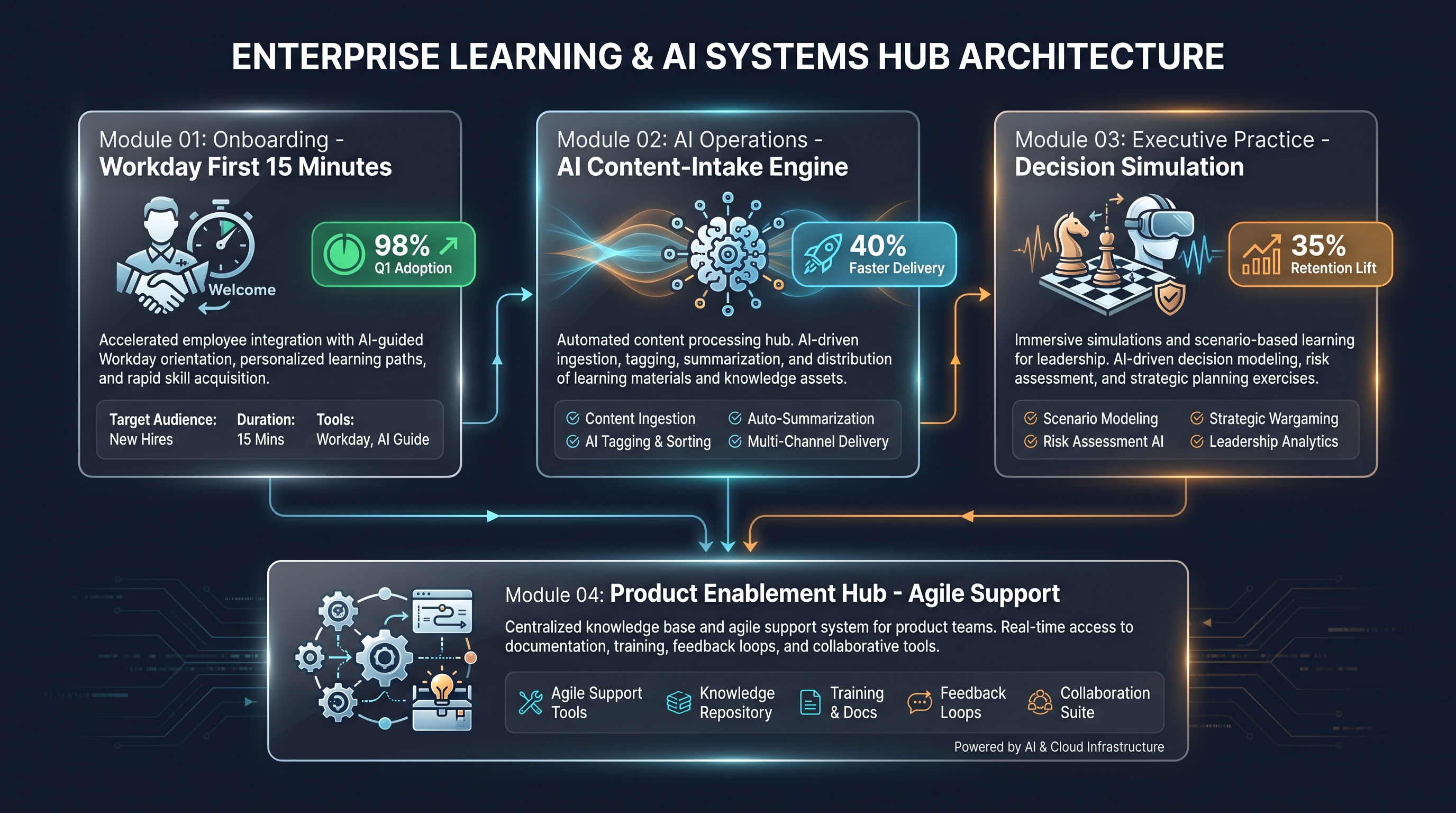
Achieved 98% platform adoption, a 40% reduction in content development cycles, and a 35% lift in executive knowledge retention by designing an integrated, user-centered learning portal ecosystem.
Overview & Live Demonstration
This integrated showcase demonstrates how enterprise learning design, UX prototyping, and human-in-the-loop AI systems converge into a single unified digital experience.
The Enterprise Challenge
Large-scale technology transformations and strategic rollouts frequently stall when systems are deployed without considering user friction:
Platform Disconnect: Employees face high cognitive load and confusing navigation during LMS rollouts.
Production Bottlenecks: Instructional teams spend excess time on manual drafting and revisions while risking brand, privacy, and accessibility standards when experimenting with ungrounded AI.
Passive Leadership Training: Senior executives disengage from static, theoretical slide decks that fail to simulate realistic business trade-offs.
Technical Complexity: Cross-functional technical releases from Product, Engineering, and Cybersecurity overwhelm operational staff when delivered as raw documentation.
My Role & Personal Ownership
Lead Learning Experience Designer & AI Workflow Architect
Owned: End-to-end user experience (UX/UI) design in Figma, stakeholder consulting across executive leadership and product teams, instructional architecture, prompt engineering frameworks, and adoption analytics.
Facilitated: Cross-functional discovery sessions with AVPs, Product Owners, Engineering Leads, and Learning Operations.
Focus: Enterprise platform adoption and frictionless onboarding.
UX Strategy: Designed a 3-step progressive disclosure model (Configure Focus → Discover Role Pathways → Build Queue) paired with a dedicated People Manager Enablement Drawer.
Outcome: Drove 98% adoption in Q1 by replacing generic system tours with actionable, time-bounded first steps.
Pillar 2: AI Production Workflow & Content-Intake Engine
Focus: Scalable generative AI enablement with rigorous human-in-the-loop quality controls.
UX Strategy: Prototyped a standardized intake and task-to-tool matrix matching LLMs (Claude, Copilot) and media generation (Synthesia, ElevenLabs) to specific tasks while establishing non-negotiable human review gates for factual verification, brand voice, and Section 508 accessibility.
Outcome: Reduced content development time by 40% team-wide.
Pillar 3: Cox 20/20 Executive Simulation
Focus: High-stakes strategic decision-making for VP and SVP leaders.
UX Strategy: Built interactive branching scenario cards that place leaders into realistic enterprise dilemmas requiring immediate trade-offs, consequence analysis, and cohort deliberation.
Outcome: Increased strategic knowledge retention by 35% compared to traditional presentation formats.
Pillar 4: IHG Product Enablement Agile Hub
Focus: Translating complex platform and workflow changes into role-based performance support.
UX Strategy: Created a sprint-aligned enablement suite combining one-page visual job aids, microlearning modules, and structured release FAQs mapped to two-week deployment cadences.
Outcome: Established a standardized, team-adopted storyboarding and intake framework bridging Product/Engineering and front-line operations.
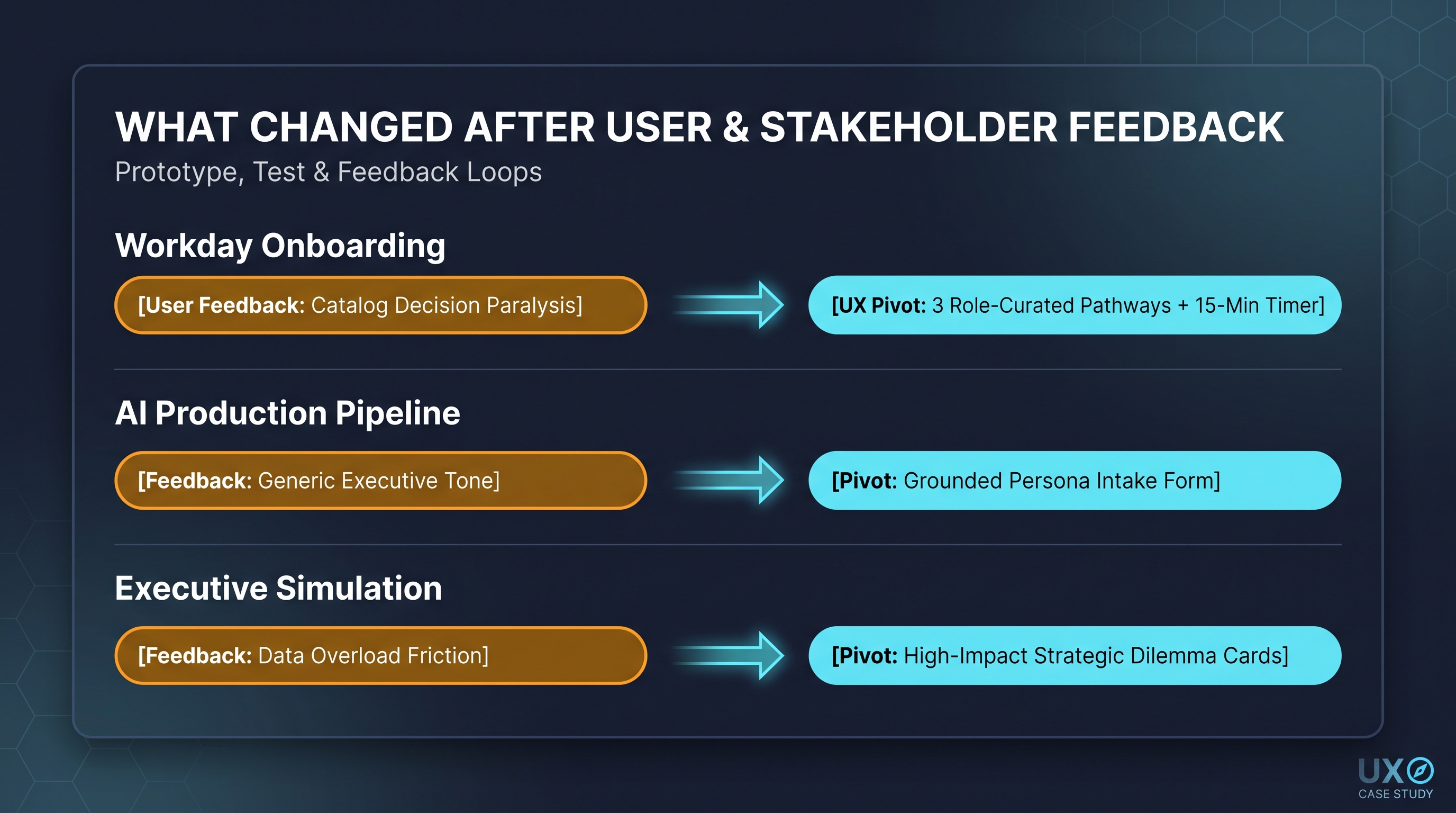
Prototype, Test & Feedback Loops
Tools, Methods & Technologies
UX/UI & Prototyping: Figma, Auto Layout, Component Design Systems, User Journey Mapping, Wireframing.
AI & Media Systems: Claude, Microsoft Copilot, ChatGPT Enterprise.
Transferable Impact: Demonstrates the ability to translate complex business objectives into intuitive digital learning products, optimize production operations with emerging technology, and consult effectively across all levels of leadership.
What I Would Scale Next: Incorporate real-time analytics telemetry directly into the front-end interface to dynamically adapt learning paths based on live user engagement signals.
AI Use & Confidentiality Statement
AI Use & Confidentiality: Assistive AI tools were utilized for workflow optimization and content scaffolding. All instructional frameworks, UX prototypes, strategic decisions, and visual systems were designed and verified personally. Client-specific workflows, proprietary systems, and internal data have been sanitized or reconstructed as original demonstration artifacts.
Available for work
Serving clients and helping them achieve their goals